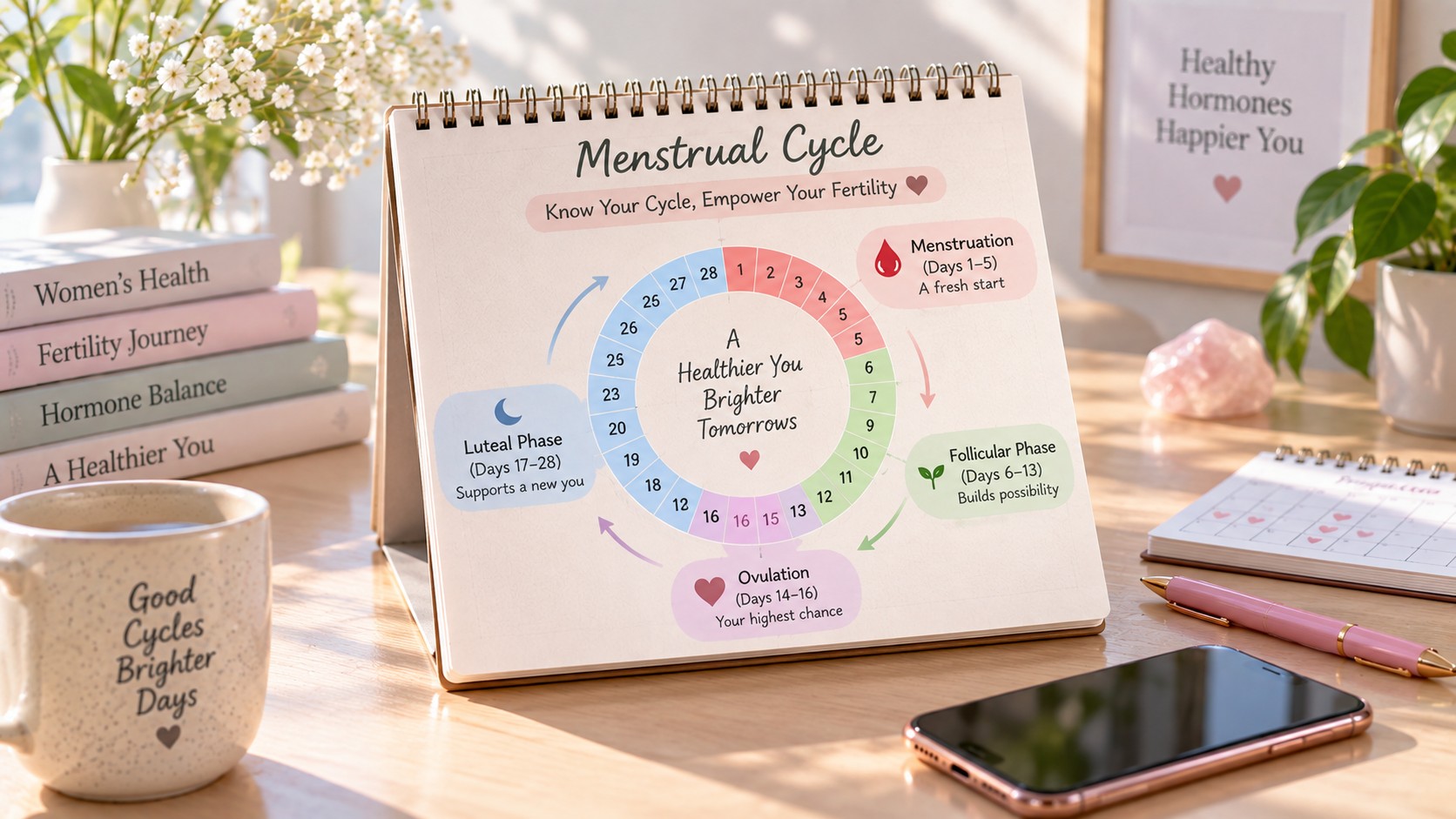
Most of us learn to think of our period as the whole story of our cycle. In reality, your period is just one part of a four-phase hormonal rhythm that repeats roughly every month — and understanding each phase is one of the most practical things you can do if you're trying to conceive naturally.
Day 1 of your cycle is the first day of full bleeding. During this phase, the uterine lining from the previous cycle sheds because pregnancy did not occur. Estrogen and progesterone are both at their lowest points.
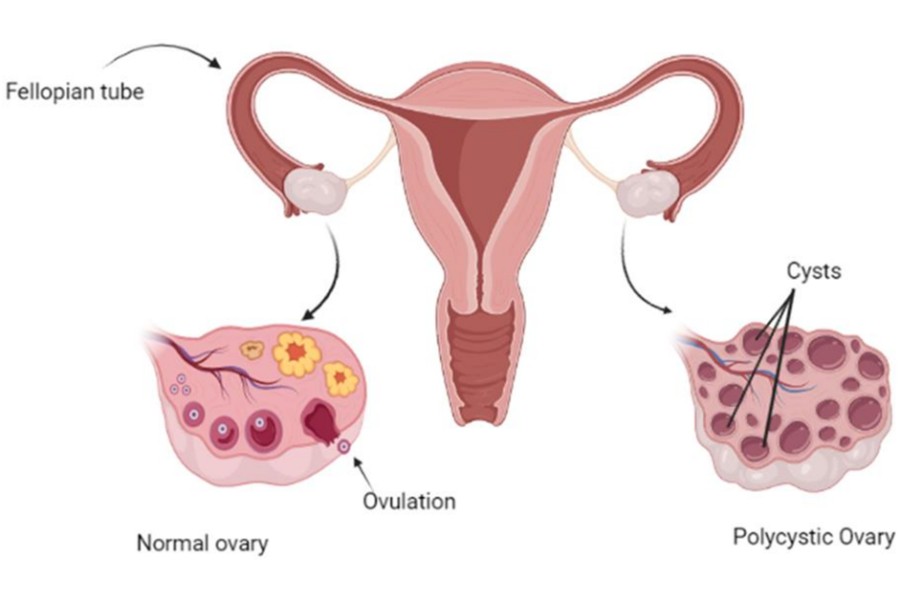
This phase technically starts on Day 1 and runs until ovulation. The pituitary gland releases follicle-stimulating hormone (FSH), prompting several follicles in the ovary to start maturing. Usually one becomes dominant. As it grows, estrogen rises and begins rebuilding the uterine lining.
A surge in luteinizing hormone (LH) triggers the release of the mature egg from the ovary. This is the single day each cycle when conception is possible, and it's the reference point for the fertility window described below.
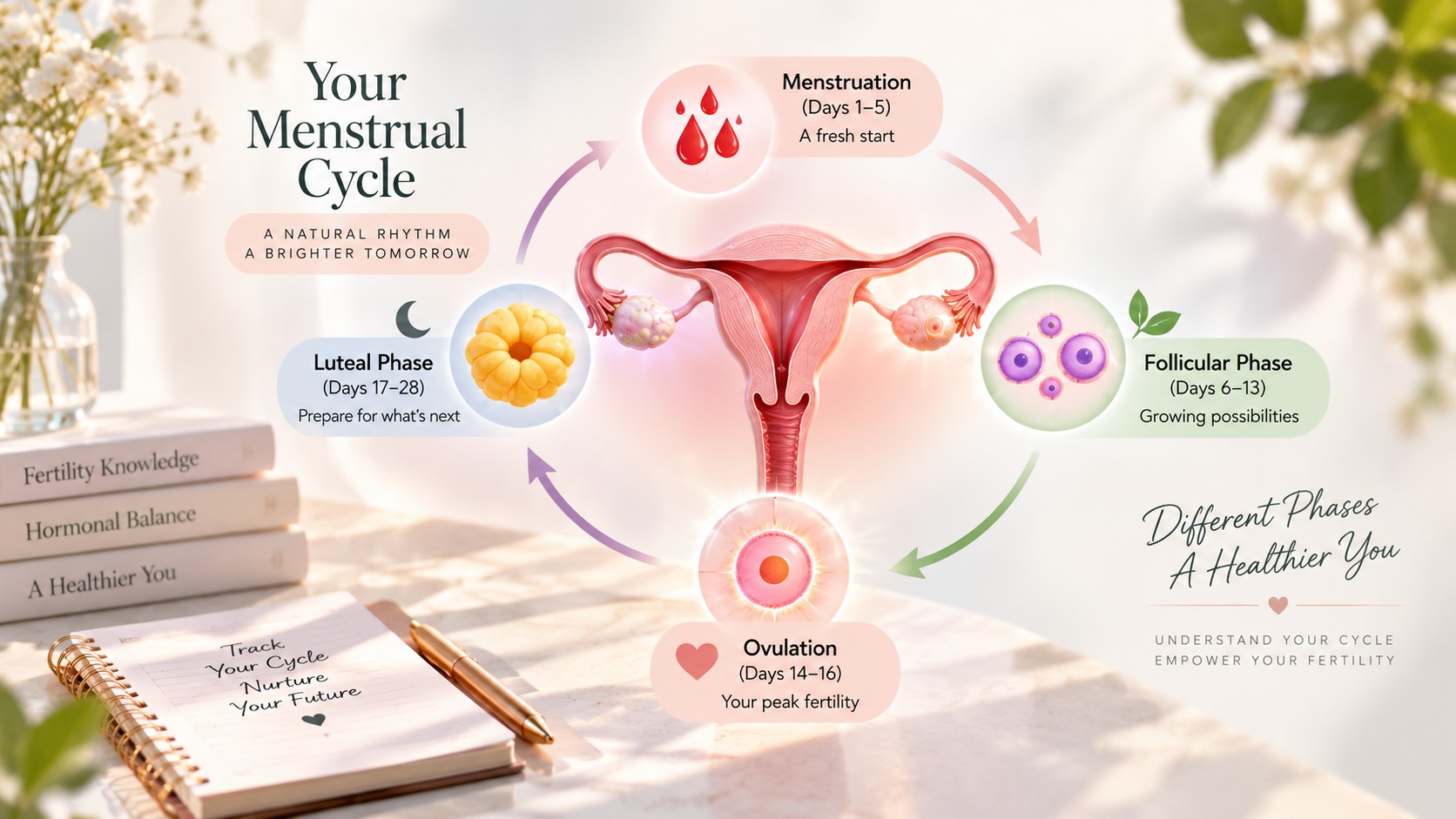
After ovulation, the empty follicle transforms into the corpus luteum, which produces progesterone to prepare the uterine lining for a possible pregnancy. If the egg isn't fertilized, hormone levels drop, the corpus luteum breaks down, and the next period begins — restarting the cycle. This phase is usually more consistent in length (around 12-14 days) than the follicular phase, which can vary more from person to person.
The fertility window is the span of days in your cycle when conception is possible. Because sperm can survive in the reproductive tract for up to about five days, and the egg is viable for roughly 12-24 hours after release, the fertility window is generally considered to be the five to six days ending on the day of ovulation. Conception is most likely on the day of ovulation itself and the one to two days before it.
If your cycles are very irregular, calendar-based estimates alone may be unreliable, and combining a couple of these methods — or speaking with a healthcare professional — tends to give a clearer picture.
"Day 14" is only an average. A healthy cycle can be anywhere from about 21 to 35 days long, and ovulation moves with it. Because the luteal phase tends to stay fairly steady at around 12 to 14 days, a simple way to estimate ovulation is to count back about 14 days from the day you expect your next period.
These are estimates, not rules. Your body may ovulate a little earlier or later from one month to the next, even when your cycles feel regular. If you want a quick starting point, our ovulation calculator guide walks through the math step by step.
You do not need a perfect schedule to conceive. A relaxed, steady approach often works better than chasing a single "perfect" day.
Trying to conceive isn't only about timing intercourse around ovulation — though that matters. It's also about recognizing when your own cycle pattern doesn't match the "textbook" 28-day version, since that mismatch is often the first clue that hormonal support, lifestyle adjustments, or a medical evaluation could help.
Many small variations are normal. Still, it is worth booking a visit if you notice any of the following:
A provider may suggest simple blood tests to check hormones, or an ultrasound, to understand what is happening. If your cycles feel unpredictable, our guide to irregular periods and hormone balance is a good next read.
AGO Mom is formulated to help support the hormonal balance that underlies a healthy, predictable cycle, as part of preparing your body for pregnancy.
Message AGO Fertility Care and share your typical cycle length and pattern. Our team can help you think through tracking methods and a personalized care routine that fits your body.
Chat With AGO on WhatsApp