You've counted the days more than once. Your period was supposed to arrive days ago, and it hasn't. The first thought is often pregnancy — but a delayed period has many possible explanations, and most of them are not cause for alarm.
Understanding why your period might be late can help you decide what to do next: wait it out, take a test, adjust a few habits, or reach out for support.
A period arriving a few days after your usual date is common and rarely meaningful on its own. Doctors generally consider a period "delayed" when it is more than 7-10 days past your expected date. If this becomes a repeated pattern rather than a one-off, it's worth paying closer attention.
If you're sexually active and your period is late, a home pregnancy test is the simplest first step. Testing too early can give a false negative, so if your period still hasn't arrived after a few more days, a repeat test or a visit to a clinician is a reasonable next step.
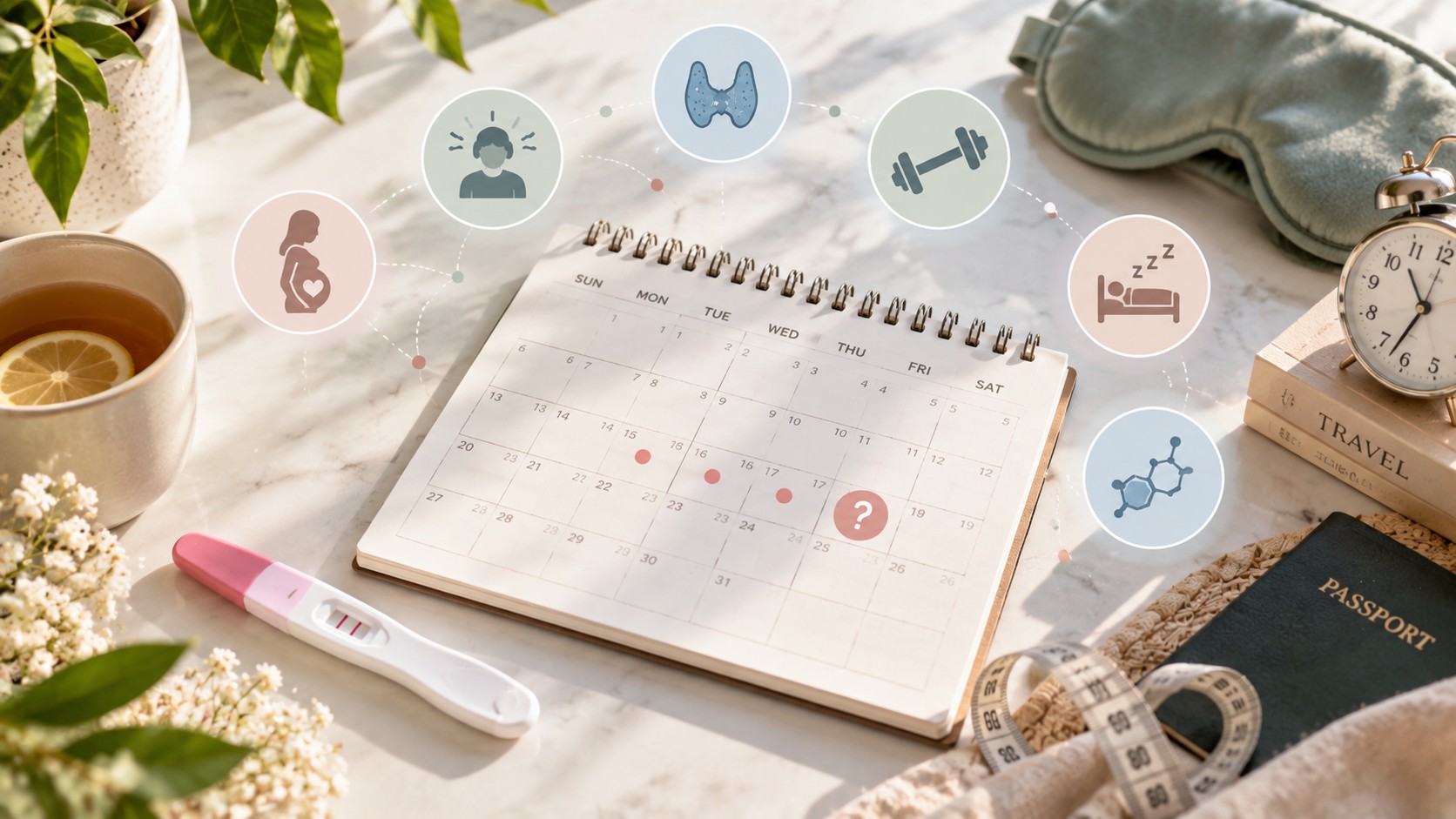
Significant emotional or physical stress — a demanding work period, travel, illness, or a major life change — can affect the hormonal signals that trigger ovulation, which in turn can push your whole cycle later than usual.
Rapid weight loss or gain, or a sudden increase in intense exercise, can be enough to delay ovulation and, with it, your next period.
If delayed periods happen often, an underlying ovulation disorder such as PCOS may be part of the picture, especially alongside other signs like acne, hair changes, or difficulty conceiving.
Thyroid hormone levels that are too high or too low can interfere with ovulation and delay periods, sometimes along with symptoms like fatigue, weight changes, or feeling unusually cold or warm.
Crossing time zones, irregular sleep, and disrupted daily rhythms can all temporarily shift the timing of ovulation and, as a result, your next period.

Hormonal contraception, some antidepressants, and a few other medication categories can affect cycle timing. If you've recently started or stopped a medication, it's worth mentioning when you track your symptoms.
A few other situations can also push a period later. These include breastfeeding, the first months after stopping the pill, using emergency contraception, a recent illness with fever, and the natural cycle changes of perimenopause in your 40s. A recent miscarriage or pregnancy loss can also shift the timing of the next few cycles while hormones settle.
Most delayed periods come down to one thing: ovulation happened later than usual. After you ovulate, the second half of your cycle (the luteal phase) tends to last a fairly steady 12 to 14 days. The first half is the part that stretches. So if stress, travel, or illness pushes ovulation back by a week, your period usually arrives about a week late too.
This is why a late period does not always mean something is wrong. It often just means your body took a little longer to release an egg that month. If you want to understand the phases in more depth, see our guide to menstrual cycle phases and your fertile window.
A single late period after a hard month is very common. A repeating pattern tells a different story. Simple tracking helps you see which one you are dealing with:
If you see a repeating pattern, our article on irregular periods and hormone balance covers the next layer of possible causes.
If delayed or unpredictable cycles keep recurring, AGO Eva is formulated to help support menstrual-cycle regularity and general gynecologic wellness as part of a broader care routine.
Consider speaking with a healthcare professional if your period is more than two weeks late with a negative pregnancy test, if delays happen three months or more in a row, or if you notice other symptoms such as significant pain, unusual bleeding, or signs of a thyroid or hormonal condition.
Message AGO Fertility Care and share how long your period has been delayed, your usual cycle pattern, and any other symptoms. We'll help you think through possible next steps and a care routine that fits your situation.
Chat With AGO on WhatsApp