An ultrasound mentioning an "ovarian cyst" can sound alarming, but the reality is that ovarian cysts are extremely common, and most are a normal part of how the ovaries work each month. This guide explains what's typical, what's worth a closer look, and how cysts are usually managed.
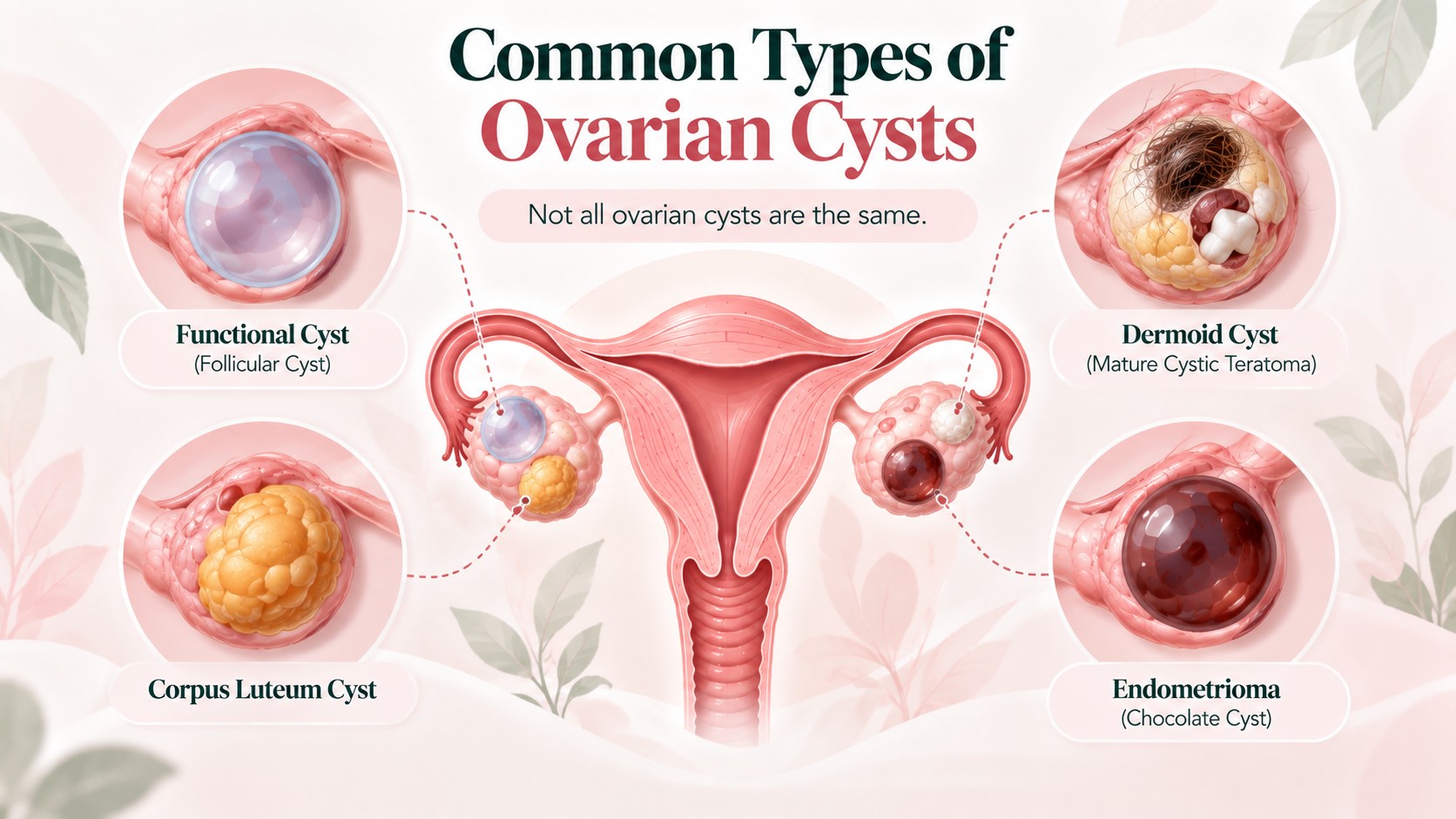
An ovarian cyst is a fluid-filled sac that forms on or inside an ovary. Every menstrual cycle, the ovary grows a small follicle to release an egg; when that process doesn't follow its usual pattern, a fluid-filled sac can form instead. Most cysts are entirely harmless.
Many cysts cause no symptoms at all. When they do, symptoms often depend on the size of the cyst and where it sits. You might notice:
These signs are common to many other conditions too, from digestive upset to normal ovulation pain. That is why a scan, not symptoms alone, is used to confirm a cyst.
Small, functional cysts often cause no symptoms at all and are found incidentally during a routine ultrasound. Even when they do cause mild symptoms — a dull ache on one side, or slight bloating — most resolve without any treatment within a few menstrual cycles.
If cysts appear alongside irregular cycles, it's also worth discussing PCOS, which can cause many small follicles to remain on the ovaries. Read our PCOS 101 guide here.
Most cysts are found with a pelvic ultrasound. Often this is a transvaginal ultrasound, where a slim probe is placed in the vagina to get a clear view of the ovaries. It is usually quick and not painful. The scan shows the size of the cyst, whether it is filled with simple fluid, and whether it has any solid parts.
Your provider may also suggest a pregnancy test, since early pregnancy can cause a corpus luteum cyst. In some cases, blood tests that check hormones are used, especially if PCOS is being considered. A blood test called CA-125 is sometimes ordered in specific situations, though it can be raised by many harmless conditions too.
For a small, simple cyst, the most common plan is "watchful waiting". This means a repeat ultrasound after a few cycles to make sure it has shrunk or gone. Larger cysts, cysts that do not go away, or cysts causing strong symptoms may be talked about in more detail, and surgery is one option a doctor may discuss.
If you are trying for a baby, finding a cyst can feel worrying. Here is the reassuring part. Functional cysts are a sign that your ovaries are going through their normal monthly cycle. They usually do not stop you from getting pregnant, and they often fade by themselves.
Some cysts do deserve a closer look when you are trying to conceive. Endometriomas are linked with endometriosis, which can affect fertility. Many small follicles seen together on a scan, along with irregular cycles, can point toward PCOS. In both cases, a provider can help you plan next steps. You can also learn how your monthly cycle works in our guide to cycle phases and your fertile window.
If you have been trying for 12 months (or 6 months if you are 35 or older), it is a good time to talk to a provider, whether or not a cyst has been found.
AGO Tumor and AGO Eva are formulated to help support the health foundation of women managing ovarian cysts or general gynecologic concerns, alongside regular monitoring from a healthcare professional.
Message AGO Fertility Care and share what your scan showed and any symptoms you've noticed. We'll help you understand what to watch for and a supportive care routine.
Chat With AGO on WhatsApp